
Composting
Composting is a simple and effective way to keep organic materials, such leaves and yard waste, out of the landfill. When organic waste is buried in a landfill, it breaks down without oxygen and produces methane, a potent greenhouse gas. By composting these materials instead, residents can help reduce greenhouse gas emissions, extend the lifespan of local landfills, and create a nutrient-rich soil amendment that can be used to improve gardens, lawns, and landscaping. Composting is an environmentally responsible practice that turns waste into a valuable resource while helping to keep our community clean and sustainable.
The RM of Hanover provides curbside compost collection services to all five Local Urban Districts (LUDs) within their respective boundaries.
To ensure collection, all compostable materials must be placed inside the green curbside compost bin. Materials placed beside the bin will not be collected.
If you do not currently have a compost bin, please contact the RM of Hanover by email at worksandoperations@hanovermb.ca or by phone at 204-346-7129 and staff will be happy to assist you.
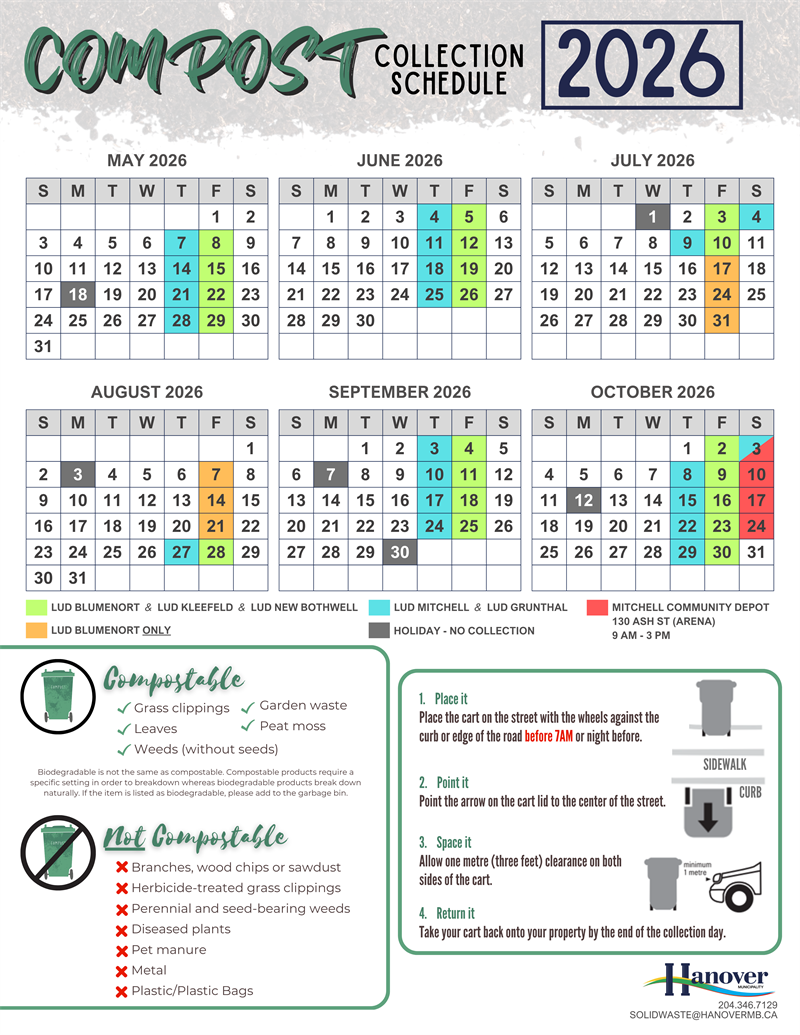
Printable Compost 2026 Schedule
Steinbach Landfill
If residents have too much compostable materials to fit into the curbside collection bins or are outside of the collection area, materials are also accepted year-round at the Steinbach Landfill (Located at 105 Hanover Road East) free of charge.
Not sure what you can compost? 🌱
Check out the lists below to make composting easy and eco-friendly.
| Compostable | What NOT to Compost |
|
|
Consider Mulching (also called Grass Cycling)
Mulching is the practice of leaving grass clippings on your lawn when mowing. Proper mulching requires a mulching blade - they are readily available at hardware stores - however mulching is a natural fertilizer (saving money), does not require bagging (saving time), and keeps organic materials out of the Landfill.
Mulching Tips
- Mow high. Adjust the mower height to leave your lawn 3-31/2 inches long. Never cut off more than 1/3 of the grass height.
- Mulch it. Use a mulching mower to reduce the size of the clippings. They will break down and release nutrients to your lawn more readily.
- Keep it sharp and dry. A dull blade can damage grass. Sharpen mower blades annually and mow when the grass is dry.
- Alternate mowing direction. This keeps the grass from being pushed over in just one direction and being damaged by the sun.